
DOT Tie-Down Requirements Explained
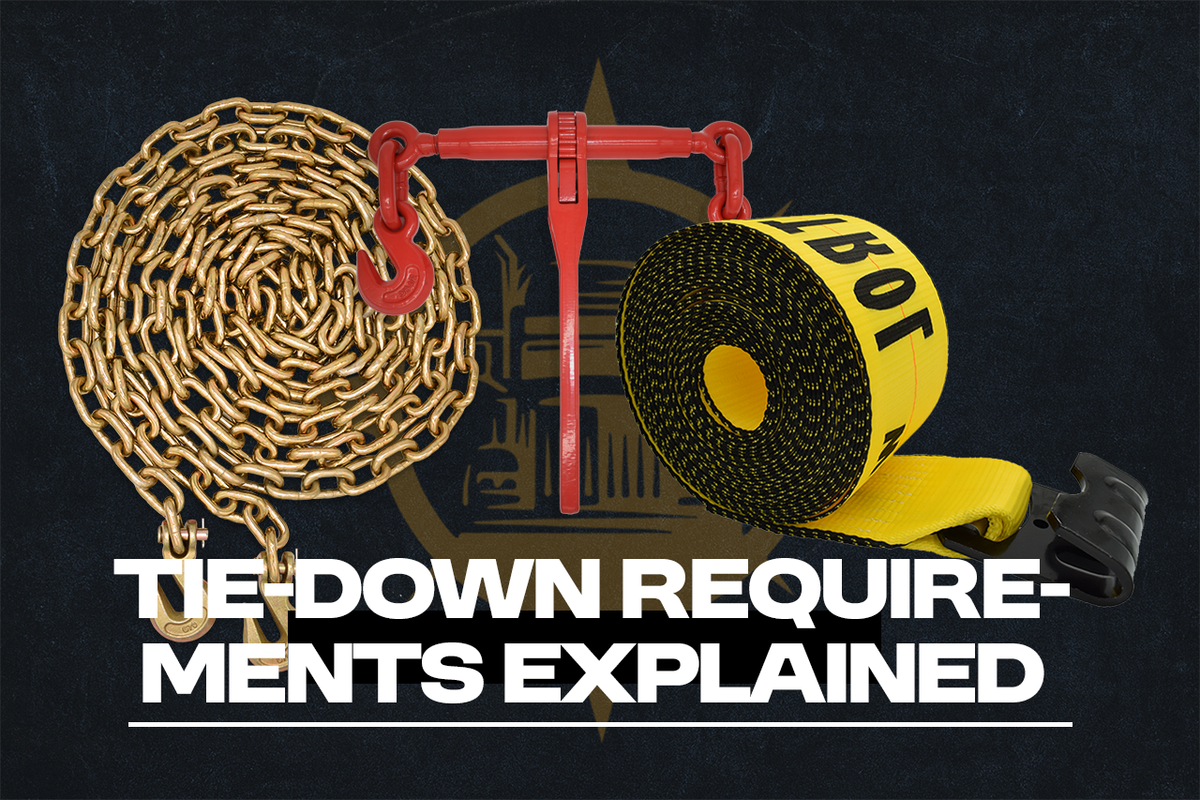
DOT Tie-Down Requirements Explained (Without the Legal Jargon)
If you’ve ever asked “Is this enough chains?” or “How many straps do I need?”, you’re not alone. DOT / FMCSA cargo securement rules can feel like a maze — but the core requirements are actually pretty simple.
This guide breaks down the minimum number of tie-downs, the 50% Working Load Limit rule, and what changes when you’re hauling heavy equipment. Then we translate it into plain Northgate terms: chains, ratchet straps, winch straps, binders, and edge protection.
Minimum number of tie-downs
DOT / FMCSA rules require two things: (1) a minimum number of tie-downs based on cargo length/weight, and (2) enough rated strength (Working Load Limit) to hold the load.
Tie-down minimums (general freight rule)
| Cargo length / weight | Minimum tie-downs |
|---|---|
| 5 ft or less AND 1,100 lbs or less | 1 tie-down |
| 5 ft or less AND more than 1,100 lbs | 2 tie-downs |
| Longer than 5 ft up to 10 ft (any weight) | 2 tie-downs |
| Longer than 10 ft | 2 for the first 10 ft, plus 1 more for every additional 10 ft (or fraction) |
Note: There are additional rules if cargo is blocked or braced against forward movement (like fully immobilized against a bulkhead), but most flatbed setups should follow the table above unless you’re 100% sure your load qualifies for the alternate method.
Translate DOT “tie-downs” into Northgate products
At Northgate Cargo Control, that usually means:
- G70 transport chain (used with lever binders or ratchet binders)
- Ratchet straps (common for pallets, lumber, bundled freight)
- Winch straps (common for flatbeds with winches and rub rails)
The 50% Working Load Limit (WLL) rule
DOT doesn’t just care how many chains/straps you used — it also cares about their rated strength. The rule: the combined (aggregate) WLL of your tie-downs must be at least one-half the weight of the cargo being secured.
Hauling a 20,000 lb machine → your tiedowns must add up to at least 10,000 lbs of WLL.
This is why a load might meet the tie-down count but still fail inspection if the straps/chains are underrated or tags are missing.
Pro tip: make sure tags/markings are readable. If a strap has no tag, some enforcement officers may treat it as unrated.
Chains vs. straps: what most customers use
DOT rules apply to both chains and straps. The difference is matching the right tool to the cargo.
Chains (G70 + binders)
- Heavy machinery & equipment
- Steel, pipe, high-abrasion loads
- Loads where sharp edges can damage straps
Straps (ratchet / winch)
- Pallets, lumber, bundled freight
- General flatbed loads with smooth edges
- Fast securement with consistent tension
Heavy equipment (10,000+ lbs): minimum 4 tie-downs
When hauling wheeled or tracked equipment that weighs 10,000 lbs or more, the rule of thumb you should follow is: use at least four tie-downs. Most operators secure two in front and two in the rear, placed as close as practicable to the equipment’s securement points.
Buckets, blades, booms, and other accessories must be in the required transport position and secured so they cannot swing or shift.
Common DOT mistakes
- Meeting the tie-down count but failing the 50% WLL math
- Using gear with missing or unreadable tags/markings
- Not using edge protection where straps contact sharp edges
- Using undersized binders/hooks compared to the chain rating
- Leaving equipment attachments unsecured
Most common Northgate setups (real-world)
Here are common product “bundles” customers build based on the rules above. (Always confirm your own load and WLL requirements.)
Flatbed general freight
- Winch straps or ratchet straps (rated + tagged)
- Edge protectors for corners/abrasion points
- Optional: coil racks / dunnage for stability
Machinery / equipment hauling
- G70 chain + binders (lever or ratchet)
- 4 tie-down minimum for 10,000+ lb equipment
- Extra chain for attachments (bucket/blade)
Steel / high-abrasion loads
- G70 chain + binders
- Corner/edge protection where needed
- Hardware that matches chain WLL (hooks, grab hooks)
Quick compliance checklist
- Count tie-downs based on cargo length/weight
- Confirm the 50% aggregate WLL requirement is met
- Use rated gear with readable tags/markings
- Add edge protection where straps contact sharp edges
- For 10,000+ lb equipment: use at least four tie-downs and secure attachments
Want a DOT-friendly setup that’s easy to repeat?
Northgate Cargo Control can help you match the right chain, binder, and tie-down count for your typical loads — so you’re not guessing at the yard or at a scale.
Build Your Tie-Down Setup